A Message from the Kalever Rebbe |
|
|
The Corrupt Teachers in Public Schools Are Damaging Souls |
|
|
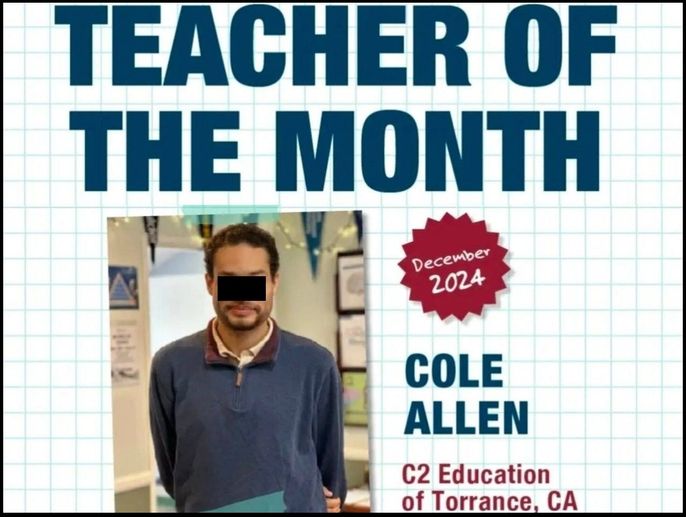
| The teacher who made the assassination attempt in Washington on April 25, 2026 |
|
|
|
"He shall not defile himself for any soul among his people..." (Vayikra 21:1) |
|
|
It is told about the Greek philosopher Aristotle that one day his students went to visit him at his home. They were stunned by what they saw: in his lust for food, he had snatched up a live rabbit and was biting and eating from it as the animal squirmed in his hands. |
|
|
His students asked him: "Are you not the great philosopher Aristotle, who teaches us manners and proper conduct? Among other things, you have taught us, that a decent person must be careful not to cause pain to a living creature. How can you be eating an animal alive — with such cruelty?" |
|
|
Aristotle answered them: "When I teach geometry and explain what a triangle is, am I expected to be a triangle myself? Of course not. I am only the one explaining. So too here — I am only explaining what proper manners are. What each person actually does is up to him." |
|
|
And he added: "When I am teaching, I am Aristotle the philosopher. But right now, while I am eating, I am not Aristotle the philosopher. I am just an ordinary man, living his private life according to the cravings of his heart." |
|
|
Lofty Words, Brutal Lives |
|
|
This is something that has been seen in every generation among the wise men of the nations who follow in Aristotle's footsteps. Even when they would lecture and preach about good middos and lofty ideals, and outwardly appeared to be exceptional people of refined character — in their private lives, in their actual conduct, they could behave as utterly corrupt people, slaves to the lowest of desires. |
|
|
The tzaddik R' Mordechai Chaim of Slonim zt"l once observed something striking. We see - he said - that during the very period when the wise men of the nations began to speak more and more about the importance of peace and unity, and to that end devised and spread new philosophies in the world about how every man can do as he pleases and live in tranquility — that was precisely the period when the world filled up with murder. They even invented the atomic bomb, with which entire cities can be obliterated in a moment. |
|
|
The wicked Hitler yemach shemo also called for educating people in good middos for the benefit of mankind. Stalin yemach shemo also said that he had come to make the sun of communism shine for the good of the world. But when it came to action — when it suited their wills, in war or otherwise — they sowed destruction, murdering millions of human beings in horrific ways the likes of which the world had never seen. |
|
|
Afterward, the nations of the world gathered and founded the "United Nations," with the stated goal of always seeking compromise and peace, and thereby fulfilling the prophecy of Yeshaya for the End of Days (2:4): "Lo yisa goy el goy cherev v'lo yilmedu od milchamah" — "Nation shall not lift up sword against nation, neither shall they learn war anymore." And yet — we still witness wars and provocations between the nations growing fiercer, and a relentless arms race for ever more dangerous weapons of war. |
|
|
R' Yerucham and the Professor |
|
|
On this subject, a story is told about the gaon R' Yerucham Levovitz zt"l, the mashgiach of Yeshivas Mir, who once explained to a fellow Jew how one ought to view the results of education in the schools and universities of the nations of the world. |
|
|
R' Yerucham was traveling to recover his health in the resort town of Marienbad, where he met a Jewish professor who was far from Yiddishkeit. R' Yerucham wanted to do a chesed for him and bring him closer to the Torah. |
|
|
When he opened a conversation with him about emunah, the professor asked him: "Have you read the writings of the German philosopher Kant?" R' Yerucham answered, "No, I haven't." He asked whether he had read the works of the German thinker Haeckel. Again the mashgiach answered no. He asked again about the work of yet another of the wise men of the nations — and the answer remained the same. |
|
|
The professor was puzzled: "If you haven't read any of these great thinkers, how are you going to convince me that you are right? Perhaps the truth is to be found specifically in their words?" |
|
|
R' Yerucham answered him: "Look, I know that from the study of our holy Torah have come people great in wisdom, in good deeds, and in lofty middos — the Tannaim and Amoraim and those who came after them, down to the Chofetz Chaim and the other gedolei Yisroel of our time. All of them grew and emerged from the study of the holy Torah. Now — from all those teachings you mentioned, has anyone of that caliber emerged? Of course not. So it is clear that those teachings are empty, and there is no need to investigate or examine them any further." |
|
|
Lessons from the Shoah and Our Own Day |
|
|
Indeed, we saw with our own eyes the conduct of the Germans yemach shemam in the days of the Shoah — that precisely the people of this "advanced" nation, including their professors and their students, behaved like the most savage of beasts of prey. |
|
|
And we see in our own time, again and again, that progressive professors and teachers — those who call themselves "modern" and "progressive," the very ones who are supposed to be spreading values of good middos, of chesed and rachamim — turn a blind eye to cruel acts perpetrated by various murderers. |
|
|
They fail to condemn them or those who support them. And at times they themselves carry out acts of murder. |
|
|
The very breath of such people is profoundly damaging. We find this idea in the Midrash (Yalkut Shimoni, Tehillim 702): in Eretz Yisroel they would set up, every single mil along the roads, a special marker — a sign — that pointed the way to the nearest city of refuge for murderers. |
|
|
The Chofetz Chaim zt"l explained: why did they go to such great lengths, rather than relying on the murderer to simply ask passersby for directions? Because the very breath of a murderer — even an inadvertent one — is so contaminated and so dangerous, that even speaking with him can cause harm. And so they put up the markers and signs of direction, so that the murderer could find his own way to the city of refuge, without ever needing to speak to a fellow Yid. |
|
|
Perhaps this is what is hinted at in the warning of the pasuk: "L'nefesh lo yitamah" — "He shall not defile himself for any soul." One must be careful not to defile the soul of any son or daughter of Yisroel through study in the schools of the nations, taught by teachers whose insides are corrupt. |
|
|
Rather, "b'amav" — let them learn only "among his people," in the schools of Klal Yisroel, taught by teachers who live the deeds of Klal Yisroel. |
|
|
And on this Rashi writes: "l'hazhir gedolim al haketanim" — "to caution the adults concerning the children." The adults must be careful and watchful in this regard over the little ones — for only then will they merit to see true nachas from them. |
|
|
|
|
Comments
Post a Comment