A Message from the Kalever Rebbe |
|
|
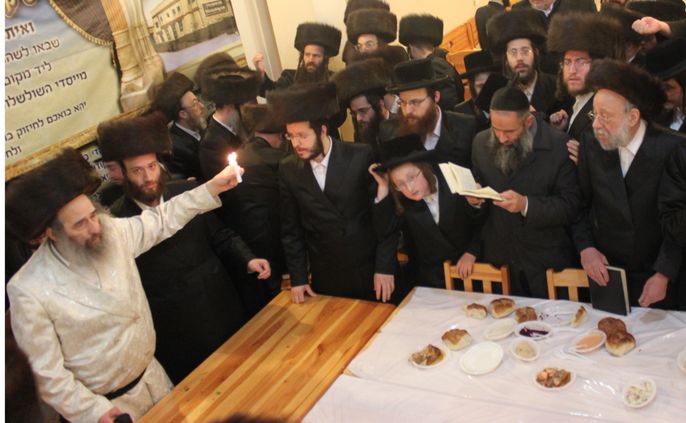
| The Rebbe at Havdalah with chasidim in Dynow, Poland |
|
|
|
And on the eighth day, the flesh of his foreskin shall be circumcised. (Vayikra 12:3) |
|
|
The Gemara records (Berachos 17a) that R' Alexandri would say the following after his tefillah: "Master of the worlds, it is revealed and known before You that our will is to do Your will. And what holds us back? The leaven in the dough and the subjugation of the nations. May it be Your will that You save us from their hand, and we will return to fulfill the laws of Your will with a whole heart." Rashi explains: "the leaven in the dough" is the yetzer hara in our hearts, which causes us to ferment. |
|
|
Chazal say (Shabbos 97a) that Bnei Yisroel are called "believers, the children of believers." Emunah is planted deep in the soul and heart of every Jew, going all the way back to Avraham Avinu who was the first of the believers, as the verse says (Bereishis 15:6): "And he believed in Hashem." And so too with Bnei Yisroel before Yetzias Mitzrayim, as the verse says (Shemos 4:31): "And the people believed." |
|
|
Chazal also taught (Kiddushin 50a) regarding the verse (Vayikra 1:3), "He shall bring it lirtzono — willingly," that we compel him until he says "I am willing" — for we know with certainty that deep down he desires atonement, he wants to return. Every Jew possesses a neshamah that is a part of Hashem Above, and in the innermost chamber of his heart he wants to be good and to do Hashem's Will. The only question is how to find the right strategy to escape the enticements of the yetzer hara. |
|
|
One of the very first pieces of counsel for someone who is stirred to return and draw close to Hashem is to accept upon himself, with a firm and complete commitment, to be especially careful in his observance of Shabbos. For through keeping Shabbos properly, l'shem Shamayim, because Hashem has so commanded, a person's da'as is elevated. He gains the ability to distinguish between bad and good. Shabbos is called in the Zohar (Vol. 2, 89a) "the day of Torah," and it is the Torah that makes a person aware of his shortcomings. |
|
|
When it comes to Shabbos, the teaching of Chazal (Avos 4:2) — "the reward of a mitzvah is a mitzvah" — is fulfilled in an exceptional way. Shabbos instills a da'as – a perception and understanding - that makes a person want to do yet another mitzvah. Through Shabbos, one understands the Torah more deeply, and the more one understands, the more one desires to fulfill the will of Hashem. For when a person is sunken in materialism and his mind is in a low place, every mitzvah feels like a burden and a weight upon him. But through the kedusha of Shabbos and the neshamah yeseirah — the additional soul — the materialism falls away and his true will is revealed. |
|
|
This is why Chazal taught (Shabbos 118b): "Anyone who keeps Shabbos according to its laws, even if he worshipped avodah zarah like the generation of Enosh, is forgiven." For through the keeping of Shabbos, a person draws upon himself complete teshuvah and complete emunah. |
|
|
The Broken Vessel Made New |
|
|
For this reason, the seforim teach that a particularly auspicious time for teshuvah is on Erev Shabbos, before the onset of Shabbos and before immersing in the mikveh. A person is like an earthenware vessel that can only be purified by breaking it. So too, when a person does teshuvah with a broken heart, he can also become purified. At that point he becomes a new vessel, and afterward he purifies this vessel through immersion in the mikvah. And then he is ready to receive Shabbos as it ought to be received. |
|
|
R' Elimelech of Lizhensk's home caretakers once related to the R' of Ruzhin, zy"a, that on Erev Shabbos after midday, there was such an atmosphere of awe and holiness of Shabbos in R' Elimelech's home that even the caretakers — who had been quarreling with each other all week long — would make peace with one another through tears, just like on Erev Yom Kippur, begging each other for forgiveness. |
|
|
It is well known what the R' of Lublin, zt"l, brings (in Zikaron Zos and Divrei Emes, Parshas Mattos) in the name of the Baal Shem Tov, zy"a. He asked: why do we say at the very beginning of Shabbos, "And on the seventh day He rested va'yinafash," which Chazal (Beitzah 16a; Zohar, Vayakhel 204b) expound as: "Vai — woe — avdah nefesh — a soul has been lost!" Surely this lament belongs at the end of Shabbos, at Motzaei Shabbos, when the neshamah yeseirah departs! |
|
|
The answer given is that the lament is over what was lost during the weekdays of the previous week. Throughout the week, a person is preoccupied with his affairs and submerged in materialism. Whatever small things of kedusha he says or does, he already considers himself a fine, upstanding person who fulfills mitzvos as he should. And even when he stumbles in various ways, the yetzer hara supplies him with a ready excuse for everything he does. |
|
|
But when Shabbos arrives, the kedusha of the neshamah yeseirah elevates his mind, and he sees clearly that over the course of the past week he has fallen from his level of holiness, and that none of his deeds were truly as they should have been. And so, the moment Shabbos enters, he cries out: "Vai, avdah nefesh" — woe for the soul that was lost during the past week! And through this recognition, he strengthens himself all the more to make use of Shabbos to lift himself and his neshamah. This gives him the courage and the strength to conduct himself in kedusha throughout the coming week as well, by the power of the holiness he has absorbed on Shabbos. |
|
|
Why Selichos Begins on Sunday |
|
|
It is brought in the seforim that this is one of the reasons for the custom of beginning the recitation of Selichos in the month of Elul on a Sunday — the first day of the week. For at that point, the heart is still under the influence of the kedusha and the teshuvah born of love from the Shabbos that has just passed. This causes the Selichos to begin with the fitting sense of awakening. |
|
|
The Sfas Emes (Parshas Tazria) explains that for this same reason, one who shows a sign of a nega – a blemish - is confined for specifically seven days. For during that period, one Shabbos will pass over him — and on that Shabbos he is especially receptive to being stirred to teshuvah out of love. Through this, he can be healed from the nega that had come upon him to awaken him to teshuvah in the first place. |
|
|
This applies in every generation: whenever events arise that call a person to teshuvah, one should strengthen himself in the observance of Shabbos according to its laws. Through this, he will merit complete teshuvah. |
|
|
This may be hinted at in the verse: "And on the eighth day" — on the day that follows Shabbos, which is the seventh day — "the flesh of his foreskin shall be circumcised." That is, through the power of Shabbos, a person becomes capable of cutting away the force of physical desire. As the Rambam explains (Moreh Nevuchim, Part 3, Ch. 35), one of the reasons for the mitzvah of milah is to weaken the power of desire. |
|
|
For the kedusha of Shabbos has the power to help a person remove the outer shell of material cravings that covers over the true, pure will buried deep within his heart. |
|
|
|
|
Comments
Post a Comment