| A Message from the Kalever Rebbe | |
|
| Tefillah b'tzibbur is more important than a business meeting | |
|
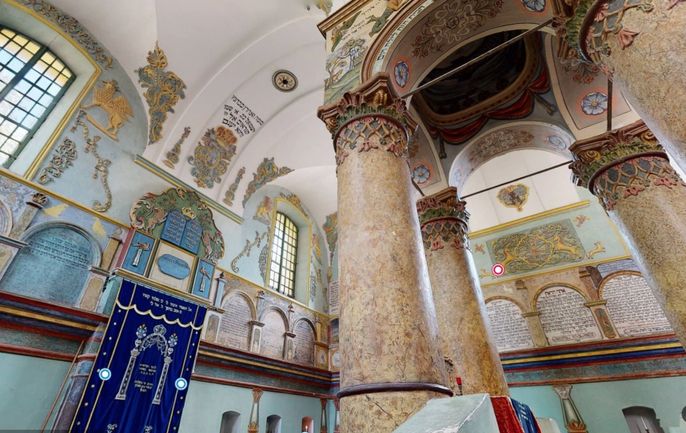 | The Synagouge of the Chozeh from Lublin in Lancut Poland |
| |
|
| "When a man among you brings an offering to Hashem, from the animals, from the cattle and from the flock shall you bring your offering." (Vayikra 1:2) | |
|
| When war broke out between Austria and France in the year 5504 (1744), the Gaon R' Yonasan Eibeshitz, zt"l, delivered a lengthy drasha in his city of Metz, which was later printed in his sefer Ya'aros Devash (Vol. 1, Drush 4). | |
|
| In that drasha, he offered words of tochachah regarding the fact that people were spending a great deal of time discussing the affairs of the war — who would win and who would lose. Such matters, he said, are fitting for ministers and officials, but what business is it of ours to waste our time on them? | |
|
| He especially rebuked those who spoke about this topics in the beis midrash during tefillah. | |
|
| We are living in a time when people are constantly receiving news from around the world, and they spend far too much time reading and discussing it. | |
|
| This has reached such a point that many businessmen and professionals have taken it upon themselves, to establish firm boundaries and safeguards for themselves, so that they will not be lured into the endless news cycle during work. | |
|
| From this we can draw a kal v'chomer: if people find it necessary to guard their time even for the sake of their livelihood, then certainly when it comes to the hours designated for serving Hashem — which is a person's primary purpose in this world — one must make every effort not to get distracted and squander the time and opportunity to serve Hashem properly. | |
|
| This is especially true when it comes to the time set aside for tefillah. | |
|
| Because of the immense importance of prayer, which accomplishes great and lofty things, the Satan exerts himself to the utmost to ensure that people will treat it lightly and not pray as they should. As Chazal say (Berachos 6b): tefillah is something that stands at the very summit of the world, yet people treat it with disdain. | |
|
| Therefore, the yetzer hara entices a person as follows: the moment he rises in the morning, it urges him to rush to begin his business dealings as early as possible, telling him that he is losing money with every moment he delays in getting to work. It convinces him not to stay until the end of davening and not to recite every bracha and answer every amen — but rather to arrive late to Shul and leave early. | |
|
| Sometimes the Satan even succeeds in convincing a person not to go to daven with a minyan at all, and instead to rush through a hurried tefillah at home. | |
|
| One can see this plainly: many people are careless with their tefillah. When the shaliach tzibbur begins davening, the person is already busy discussing the latest news and headlines. Only when the minyan is already well into the tefillah does he begin to daven in haste, without enunciating the words properly — and sometimes he even skips entire sections. If someone calls him on the phone in the middle of davening, or a friend comes over to chat, he does not restrain himself from interrupting. | |
|
| Then, when he finishes Shemoneh Esrei, he rushes to remove his tallis and tefillin as if his time is terribly pressed — yet if the opportunity arises at that moment to discuss the news, he lingers at great length, even though it brings him no benefit at all. | |
|
| All of this is the work of the Satan, to prevent his tefillah from rising and accomplishing what it should. | |
|
| A person should therefore reflect upon how much he stands to gain through tefillah b'tzibbur — davening with a minyan, which accomplishes great things, for it carries the power of the many. As Chazal say (Berachos 8a) on the verse (Iyov 36:5), "Behold, Hashem is mighty and does not despise" — Hashem does not reject the prayer of the multitude. | |
|
| The Zohar teaches this idea in many places saying that when ten Jews pray together, all the forces of accusation are nullified, and good influences are drawn down upon a person in both spiritual and material matters. | |
|
| It is brought in the holy sefer Mishmeres Isamar (end of Parshas Mishpatim, s.v. v'el atzilei) in the name of his Rebbe, the Chozeh of Lublin, zt"l, that he once advised him — in response to matters the student had raised and complained on — that he should be very careful never to daven alone, but should always go to pray with the minayn, for this brings salvation in all matters. | |
|
| This is especially vital in our times, as a means of annulling hardship and suffering. As explained in the sefer Maor V'Shemesh (Parshas Mishpatim): through tefillah b'tzibbur, even people of our humble stature can bring about healing for the sick, protection for the healthy, blessing upon one's livelihood, and the annulment of all harsh decrees. He explains the verse (Shemos 23:25), "And you shall serve Hashem Elokeichem" — if the service of the heart, which is tefillah (Taanis 2a), is performed in the plural, as implied by the word "va'avadetem" ("and you — all of you — shall serve"), then: "He will bless your bread and your water, and I will remove illness from your midst." | |
|
| Learn from the Marketplace | |
|
| The way to internalize this, is to consider what we see every day in the course of ordinary life. For the sake of a livelihood, people push themselves to do all manner of difficult things — and all for the sake of money. When a large sum is on the line, a person will rise at the crack of dawn and work until late at night; he will swallow his pride, skip meals, and set aside his own comfort without a second thought. | |
|
| If he has a meeting scheduled with someone who could help him close a profitable deal, he will move heaven and earth to arrive on time. | |
|
| How much more so, then, when it comes to tefillah b'tzibbur, which brings down blessings in both the material and the spiritual realms — should we not exert ourselves at least as much to be present for the entire tefillah with the congregation, properly and with care? | |
|
| The Hidden Call of the Verse | |
|
| With this we can explain our opening pasuk: | |
|
| "Adam ki yakriv" — when a person comes to pray, which is considered like bringing a korban, as the verse says (Hoshea 14:3), "Let our lips substitute for bulls" — "mikem korban la'Hashem" — he should pray from within the congregation, as indicated by the plural "mikem," meaning "from among you (plurarl)." | |
|
| "Min habehemah min habakar umin hatzon" — from the very effort that you invest in your cattle and flocks, that is, in your material possessions and livelihood — "takrivu es korbanchem" — learn a kal v'chomer to invest at least that same effort in your tefillah with the congregation, as it deserves. | |
|
|
|
Comments
Post a Comment