| A Message from the Kalever Rebbe | |
|
| For honoring parents - Hashem rewards beyond the natural order | |
|
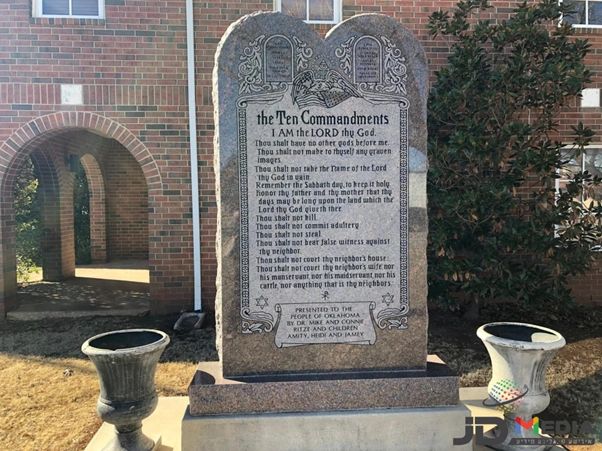 | Ten Commandments monument - Oklahoma State Capitol |
| |
|
| R' Moshe of Shinova, when his parents were struggling financially, he took upon himself the burden of traveling through towns and villages to collect funds for the family. | |
|
| At a reception held in his honor in one of the villages, there was a Jew who knew that drinking liquor was very dangerous to the Rebbe's health. Thinking he was clever, the man stood up and announced, "If the Rabbi drinks a cup of liquor, I will give a gold coin for the cause." | |
|
| The man thought this would exempt him, but the Rebbe responded and said, "I am certain that through the merit of fulfilling the mitzvah of honoring my father, the drink will not harm me." | |
|
| He then proceeded to drink the entire cup! And his health was not affected in the least. | |
|
| This story is one example among many stories that have occurred throughout the generations, where we see that through the merit of fulfilling the mitzvah of one's honoring father and mother, a person receives the reward of heavenly protection and success beyond the natural order. | |
|
| Why is the reward for this mitzvah so great? | |
|
| The Principle of Measure for Measure | |
|
| Chazal taught (Sanhedrin 90a) that all of Hashem's attributes operate measure for measure. | |
|
| Similarly, the seforim hakesohim explain (Kedushas Levi, Parashat Naso, and others) that the pasuk says "The Lord is your shadow" (Tehilim 121:5). The Baal Shem Tov explained, that just as your shadow does opposite of every movement that you do, so too Hashem "mirrors" and "shadows" a person behavior. | |
|
| The Natural Tendency to Blame Others | |
|
| It is only human to blame others for your own failures, your own struggles and challenges. | |
|
| And, people find it most convenient to blame their parents, the people who raised him, for all of these failures. There is a powerful Yetzer Harah that pulls a person towards thinking that their lives would be better if only their parents had done better parenting, provided more, etc. | |
|
| For example, if someone grew up in a home where the parents didn't care for him enough, the Yetzer Harah convinces him to blame his parents for not caring enough. And, if a person grows up in a home where they parents care for him a great deal, the Yetzer Harah takes the exact opposite: they smothered you! You needed more freedom and less caring! | |
|
| Either way, the Yetzer Harah wants a person to absolve himself of all the personal blame for his failures and place that on someone else. | |
|
| When a person regrets his sins, confesses them, and forsakes them, his teshuva will certainly be accepted by Hashem. But if instead the sinner conceals his transgressions behind blame—hanging the yoke of his guilt on his parents and claiming they failed to educate him properly—he only multiplies sin upon transgression. For such a person not only abandons the ways of his fathers to follow his own desires, but compounds this by casting blame upon his parents as well. | |
|
| Therefore, the pasuk teaches (Vayikra 26:40), "And they shall confess their iniquity and the iniquity of their fathers in the treachery that they committed against Me"—when people attribute their own iniquities and betrayals to their fathers' failings, then "I too will walk with them in opposition." | |
|
| Judging Parents Favorably | |
|
| Even when there truly is great cause to blame one's parents, we are still commanded to judge every person favorably—to see the good in them and recognize that despite whatever bad may exist, the good remains primary. When a particular incident can be interpreted either positively or negatively, we are commanded to interpret it for good. If this obligation applies to every Jew, how much more so must a person judge his own parents favorably, for the very mitzvah of honoring parents demands this of us. | |
|
| The Sefer Charedim writes, that you must honor your parents with a full heart; truthfully and sincerely. However, if you focus on the shortcomings of your parents and this causes you to disrespect or look at them negatively, the Torah describes this person as "Cursed is he who dishonors his father and his mother" (Devarim 27:16). | |
|
| Even if you parents harm you intentionally, you cannot become angry or blame them. Rather, you must remember the following teaching of the Baal Shem Tov. Chazal taght (Zohar Breishis 27b) that "whoever becomes angry is as if he worships idolatry." The Baal Shem Tov explained that a person must realize that whatever happened in his life is with Hasgacha Pratis, Divine Design and Hashem the root cause of everything that happens to you. Therefore, if a person becomes angry at another person and blames that person for doing something harmful to him, that anger is a sign that the person's emunah has weakened. After all, in their anger, there are demonstrating that they believe a person has the power to do something in this world outside the Divine Design; they are assigning power to another being besides Hashem. Therefore, anger is like idol worship. | |
|
| Beyond Nature Through Honoring Parents | |
|
| If a person always honors and respects his parents completely, and overcomes through this the human nature to blame parents — then, measure for measure, since he went beyond his natural tendencies, Hashem rewards him beyond the natural order. | |
|
| There is a similarity with this and the mitzvah of keeping Shabbos. It is natural for a person to want to work another day and earn more money at every opportunity. Therefore, one receives reward beyond the natural order when they keep Shabbos and refrain from working, as Chazal taught (Shabbos 118b) that whoever delights in the Shabbos is given an inheritance without boundaries. | |
|
| Similarly, they said (Beitzah 16a) that a person's livelihood is fixed for him from Heaven from Rosh Hashanah to Rosh Hashanah, except for expenses of Shabbos and festivals — which is against nature, for since he spent money, it should naturally be diminished from him, but in truth, through spending money on Shabbos and Yom Tov he will receive more. | |
|
| The Connection Between Shabbat and Honoring Parents | |
|
| Now, the Baal HaTurim wrote in this parsha regarding the Ten Commandments: "He juxtaposed honoring father and mother to Shabbos, to tell you, that just as one is obligated to honor the Shabbos, so is one obligated to honor his father and mother." | |
|
| What is the connection between the mitzvah of Shabbos and honoring father and mother? | |
|
| According to what we have said above, this can be easily answered: | |
|
| Just as fulfillment of the mitzvah of Shabbos is contrary to nature, so fulfillment of the mitzvah of honoring one's father and mother is contrary to nature. | |
|
| Therefore, they are juxtaposed to each other, to tell you, that both are equal, and for both one receives reward of good and long life beyond the natural order. | |
|
|
|
Comments
Post a Comment