"For the tribe of Manasseh, Gaddi the son of Susi". (Bamidbar 13:11)
A well-known and widely read newspaper, once interviewed an extraordinarily successful and wealthy businessman. The interviewer began with a question: "What is the secret to your success? How have you become so wealthy?"
"Let me tell you my story how I managed to become so wealthy," began the businessman, "When I was very young, I would sell small trinkets. And, once that business was successful, I began selling wheat. When that business grew large enough, I began selling fruit at the market. I kept expanding my business further and further, until eventually I won the country's lottery."
This is ridiculous! What does selling fruit have to do with winning the lottery? How could this man conflate being successful in business with being lucky in the lottery?
Truthfully, many people make the same absurd connection. They think that their livelihood depends on various strategies, deals, and countless calculations. However, the reality is that everything they earn, everything they have, their entire livelihood is delivered to them by Hashem, and they only need to make some natural Hishtadlus.
A Fallen Horse
The Chofeitz Chaim, zt"l, once saw a Jewish wagon driver sitting by his cart and crying. He asked him, "Why are you crying?"
"My entire livelihood depended on my horse. But, my horse had an accident and died. Now I have nothing!"
The Chofeitz Chaim replied: "You are crying because you think that your horse provided you with a living. However, once you realize that your livelihood is granted solely by Hashem, you will stop crying."
The Egyptian Horses
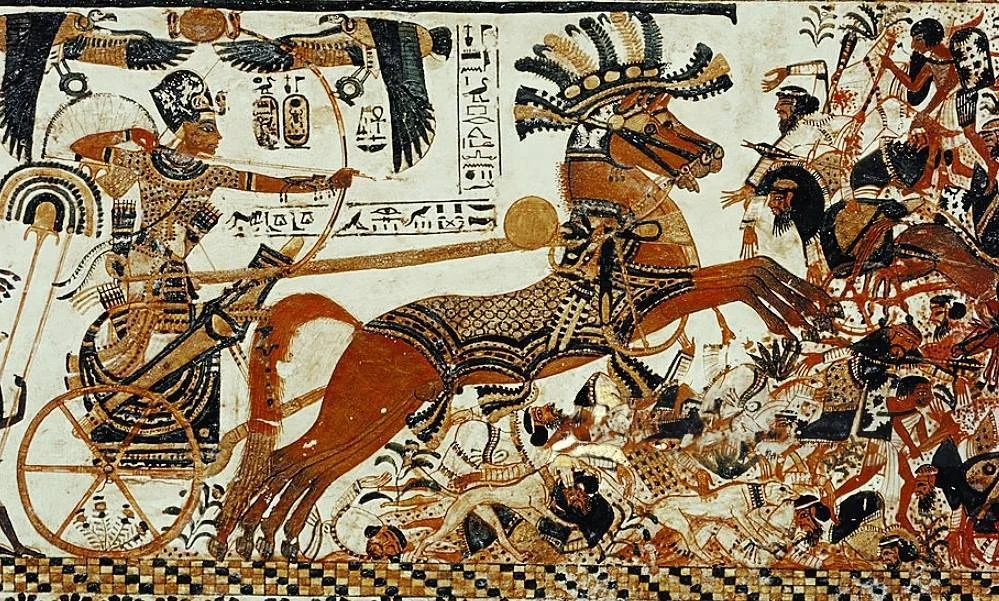
The non-Jewish nations used to cherish their horses. They would trade them and use them for war. They would dress them in beautiful and glorious armor as they marched them into battle. Their splendor was so magnificent that the Jews were compared to these battle horses as it says (Shir HaShirim 1:9), "At the gathering of the steeds of Pharaoh's chariots have I silenced you, my beloved".
Pharoah and his kingdom were very proud of their horses. The enslaved Jews were influenced by the idol worship and culture of the Egyptians. They feared that they would never be able to overpower the army and their horses. However, at the splitting of the sea, when Hashem drowned the Egyptians and their horses, the Jews were finally able to sing shira and praise Hashem, as it says (Shemos 15:1), "Then Moses and the children of Israel sang this song to the Lord, and they spoke, saying, I will sing to the Lord, for very exalted is He; a horse and its rider He cast into the sea".
Don't rely on weapons
Afterwards, Hashem told Bnei Yisroel that if they wanted to have a king, they had to be careful that (Devarim 17:16), "Only, he may not acquire many horses for himself, so that he will not bring the people back to Egypt in order to acquire many horses, for the Lord said to you, "You shall not return that way any more." The commentators explain, that they were forbidden from returning to Egypt to purchase horses, because possessing many horses weakens one's faith and trust in Hashem. Meaning, we cannot revert to that mentality of believing in might and power of the horses, like the Egyptians.
Similarly, we find many instances throughout Tanach, where the Jewish kings warned not to place trust and faith in horses, which were like our most advanced weapons today. Dovid HaMelech said in Tehilim (33:16-17), "The king is not saved with a vast army; a mighty man will not be rescued with great strength. A horse is a false hope for victory, and with his power, he will not escape". Additionally he wrote (ibid 20:8), "These trust in chariots and these in horses, but we-we mention the name of the Lord our God". And Shlomo HaMelech said (Mishlei 21:31), "A steed is prepared for a day of battle, but the victory is the Lord's".
A Play of Fools
Once, those who were part of the movement to secularize traditional Torah observance in the town of Brisk, put together a play to mock the Torah observant Jews. It was based on the section of the Torah in Parshas Shoftim that discusses which Jews were obligated to join in a war effort.
Hundreds of actors mounted their horses and appeared on the stage. One of the actors declared, "He who has planted a vineyard and has not harvested should return to his home!" Another actor then said, "Whoever has become engaged to a woman but has not married, should return home." Most of the actors departed the stage.
Then an actor declared, "Whoever is gentle and soft hearted should return home." Another group of actors exited the stage. This continued until there were only two actors left: one was dressed as the Vilna Goal, zt"l, and the other as the Shagas Aryeh, zt"l. All they had to do battle was their walking sticks and a Gemara.
When R' Chaim of Brisk, zt"l, heard about this play, he said: "This is precisely how the Jews wage war. However, they overlooked that the last scene was actually the secret to the Jews' military success: the men who were dressed like our saintly sages."
The Daas Zakeinim (Breishis 14:14) taught that before Avraham Avinu went to war against the four great kings, he said to his army, "Whoever is fearful because they have sinned should return home." And, only Eliezer remained, yet Hashem enabled him to be victorious in battle.
Forget the Egyptian culture
The Seforim HaKedoshim explain, that before Moshe sent the spies to investigate Eretz Yisroel, he alluded to the level of faith that was required to enter and conquer the land.
This might be the meaning of our pasuk. As Moshe was encouraging and preparing the Jews to conquer Eretz Yisroel and to settle there, he reminded them not to forget to abandon the cultural influences of the Egyptians.
This is alluded in his words: "for the Matte of Manasseh" – Matte can mean bending and Manasseh means forgetting – you need to bend yourself to forget the Egyptian culture that "Gaddi the son of Susi" – Gaddi means my luck and Susi means my horse - the perspective that one's mazal depended on his horse. This is what you need to forget. Rather, you need to remember that everything is from Hashem.

Comments
Post a Comment