"Justice, justice shall you pursue, in order that you should live and inherit the land which Hashem your God gives you" (Deuteronomy/Devarim 16:20)
Reb Shmelke from Nikolsburg zt"l used to distribute tzedakah to the needy. One time, a pauper approached the Holy Rebbe seeking a little bit of tzedakah. However, the Rebbe had already distributed all of his tzedakah. Not wanting to turn away a single Jew in need, the Rebbe searched his entire house looking for something – anything – to give this poor Jew in need. Finally, he found a ring in sitting a little box. The Rebbe grabbed the ring and gave it to this Jew.
Meanwhile, the Rebbetzin had heard this entire episode and she knew very well that there was nothing in the house to give; not even a single penny. After the pauper left, the Rebbetzin, asked the Rebbe what he had given the pauper. When the Rebbe told his Rebbetzin that he given him the ring that was in that tiny box, she screamed out: "What!? That ring had a precious stone worth 300 gold pieces!"
Rebbe, shocked, ran out of the house chasing down the pauper. As the Rebbe approached, the pauper saw him coming and thought that the Rebbe had a change of heart and wanted the ring back. So, the pauper began to run trying to escape. But, the Rebbe ran even faster and finally caught up to him. When he did, the Rebbe said to him: "My friend, listen very carefully. You need to know that that ring I gave you is very special: it has a rare stone that is worth over 300 gold pieces! Do not sell it cheaply!"
When relating this story, holy Nikolsburger Rebbe explained that he finally understood what Chazal meant when they taught in in Shabbos (10b) that Hashem told Moshe Rabbenu, "I have a good gift in my treasure house, and her name is Shabbos, go let the Jews know". This, explained the holy Rebbe, was a commandment to "chase" after Jews; to let them know that Hashem has given us a precious, invaluable gift: the Holy Shabbos. This is an instructive to "chase" down and let Jews know the true worth of Shabbos and that they shouldn't discard it lightly; they shouldn't trade it away for something less valuable. They should be aware of, keep and protect the Holy Shabbos' value.
When describing the mitzvah of keeping Shabbos, the passuk in Shmos/Exoduc (31:16) says: "and the Children of Israel shall keep the Shabbos in order to make the Shabbos". The Sefer Or HaChaim HaKadosh - troubled by the wording "keep the Shabbos in order to make Shabbos" – explains that there is a mitzvah, a commandment, for every Jew to "keep" and observe Shabbos. However, there is also very special, unique mitzvah to "make Shabbos" as a priority for others- to encourage and inspire other Jews to observe Shabbos as well.
This is a meaningful and precious fundamental idea. As Jews, we obviously have a privilege and obligation to keep Shabbos for ourselves, to make observing Shabbos part of our lives. However, we each also have the responsibility to help others Jews observe and keep Shabbos; to educate, inspire and help in any way we can. We need to let other Jews know about this previous gift of Shabbos.
On Friday night, we sing the zemer "Kol Mekadesh" which has a verse that says: "whoever keeps Shabbos according to the law, away from desecrating it, his reward will be greater than his work."
The holy Rebbe the Minchas Elazar of Munkatch zt"l explained that this verse is referring to this very concept. When someone is truly "Shomer Shabbos", he is someone who observes and stands guard protecting the sanctify of Shabbos for himself and others. He works to keep Shabbos holy for all Jews by encouraging them and helping them observe Shabbos. Such a person receives reward not only for his work to observe Shabbos for himself, but he receives "credit" and reward for every Shabbos that other Jew keeps for the entirety of his life.
Along this concept, there is a story that when Rabbi Zalman Sorotzkin zt"l served as a Rov in the town of Zatil, there was a young wagon driver who started to break Shabbos, and he would not humble himself to the requests and warnings of the chief rabbi of the town who told him to repent. The boy's father was able to influence him to stop breaking Shabbos, but he thought it was preferable to ignore this.
Once, Rabbi Zalman zt"l happened to be travelling on the same train as the Chofetz Chaim zt"l. A father and son boarded the train as well. The boy wasn't Shabbos observant. When the father saw the Chofetz Chaim zt"l, he went over to him to ask for a brachah to recover from an illness that had plagued him.
The Chofetz Chaim zt"l did not know this man or his son. They had never met before. However, to the amazement of the other travelers who were present, he answered with Ruach HaKodesh: "The brachos in life depend on Shabbos, the source of all blessings. If you keep Shabbos properly, then Yisrael Meir (myself) can also offer you a blessing, but without observing Shabbos, this is impossible".
The Chofetz Chaim continued and said: "Maybe you think that you observe Shabbos for yourself. But, the Torah says, 'do no labor, you, your son, or your daughter'. This is a unique warning: we don't see it anywhere else in the Torah. For example, we aren't commanded not to eat meat and milk together, you, your son, or your daughter'. On Shabbos, a father is responsible for his sons and daughters. If you keep Shabbos yourself but your son desecrates Shabbos, you are unable to receive the blessings of the Shabbos. Therefore, since you have cut yourself off form the source of all blessing, Yisrael Meir is also unable to bestow a blessing upon you."
The father was shocked by the Ruach HaKodesh of the Chofetz Chaim zt"l and the power of his words. He immediately promised the Chofetz Chaim that he would work to encourage his son to keep Shabbos. When the Chofetz Chaim heard the commitment, he blessed him and the blessing was fulfilled as he was miraculously healed from his illness.
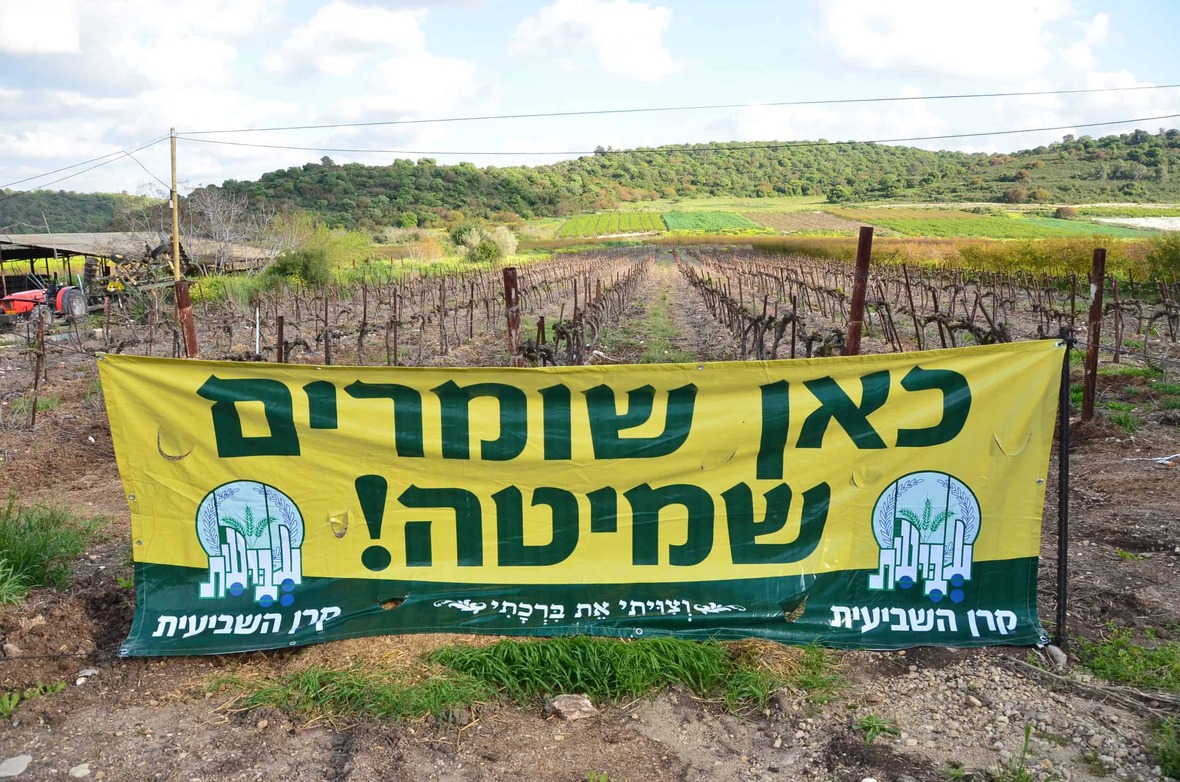
We find this concept also in the mitzvah of Shmittah. The Torah tells us that "and the land shall rest a Shabbos to Hashem" (Leviticus/Vayikra 25:2). Shmittah is a "Shabbos for Hashem." The Jews in Eretz Yisrael must observe the Shmittah year for themselves. However, just like Shabbos, we need to encourage other Jews and farmers to observe the laws of Shmittah and to rest from working their fields on the seventh year. Then, everyone will be worthy to the promise that is said of those who observe Shmittah "and I will command my blessing" (ibid. 25:21).
When the Jews observe these two mitzvos, Shabbos and Shmittah, we are demonstrating to the entire world, to every aspect of creation, that we have a pure, and powerful faith in Hashem, the Creator of the World. We refrain from work. We step back from the tasks that surround our very livelihood. We take a moment from the mundane. And, we are able to do so because we have the utmost faith that everything comes from Hashem. Our livelihood, health, well being, everything comes from Hashem. That faith empowers us to observe the Shabbos, and Shabbos fuels that faith. And, that faith is clearly seen by all in the world increasing the world's recognition of Hashem's presence in the world.
Therefore, with these tow mitzvos specifically, are we commanded to not only keep them for ourselves, but work to ensure that others do as well. By encouraging others to observe Shabbos and Shmittah, we are multiplying the number of people who demonstrate this faith. And the world sees. In this merit they are worthy to Geulah.
This can explain the redundancy here of "justice, justice pursue". The word justice alludes to faith as explained in the Zohar Hakodesh in Parshas Balak (198b) that should run to encourage Jews to keep the mitzvos of Shabbos and Shmittah, which declares our faith to the world, "in order that you should live and inherit the land which Hashem your God gives you". Through this avodah, this effort, you become worthy for a good and blessed life and the full Geulah soon in our days, Amen.
Comments
Post a Comment