And to the children of Israel, you shall speak, etc….to slaughter before the Lord, for today the Lord will appear to you. (Leviticus Chapter 9 verses 3-4)
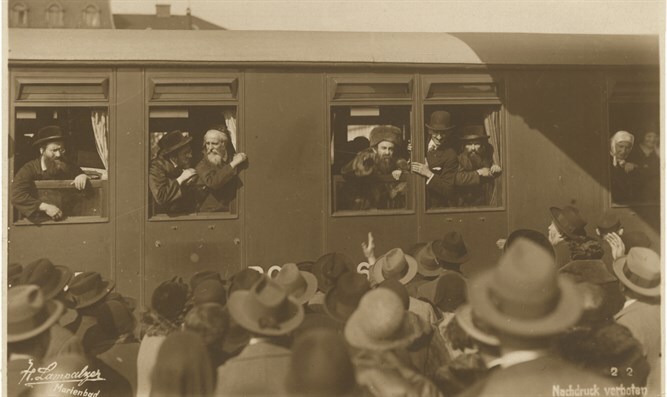
The holy Bobover Rebbe, Rebbe Shlomo Halberstam zt"l, once told me in the name of his father, the holy Rebbe Ben Tzion of Bobov zt"l, author of Kedushas Tzion, that his uncle the Holy Rebbe the Divrei Yechezkel of Shineve, zy"a, on his way home on a journey, once stopped at a certain city. Many people came to his lodging place to request a blessing. In the middle of receiving the visitors, the Holy Shinever Rov said to his gabbaim "It is time to go back to the train station, as the train is leaving soon". The gabbaim (who were being paid by the petitioners) wanted to get more money, so they answered "it is not late yet".
However, the Shinever Rov held that they should hurry, so they should not worry about being late for the train. He wanted to teach a lesson to those that were present how to serve Hashem. He cried out, "Why should we wait until it is too late?! Why shouldn't we hurry up to return while there is still time?! The Torah says 'get up before old age' (which simply means to rise in the presence of elderly people or sages). We could translate this to mean that you should get up and repent before you get too old! You shouldn't push things off until it is too late!" When these words came out from the mouth of the Tzaddik, all of those listening were inspired to do teshuvah, and they all became filled with tremendous awe, to the point where nobody else ventured to request to receive the Rebbe's brachah.
These words have an important lesson for every Jew who wants to do teshuvah. The Seforim HaKedoshim bring in the name of the Baal Shem Tov zya, that Chazal say that "every day a Heavenly Voice goes forth saying, 'return ye rebellious children!'" (Avos 6:2), yet the Baal Shem Tov asks why we do not hear this Voice? What is the point of a Voice we cannot hear?! The Baal Shem Tov explains that this voice is the feeling that inspires us to repent, which comes from Heaven, into the mind of every Jew, without exception. (Toldos Yaakov Yosef – Parshas Kedoshim, et al) Even the worst wicked Jew cannot spend an entire day without one moment that he thinks of turning his life around. Most people dismiss these feelings as coming from depression, therefore they try to push away these thought by engaging in addictive activities such as drinking alcohol or other addictions.
According to these words from the Baal Shem Tov zy"a, we can understand what we see clearly, that Jews tend to be the people with the least satisfaction in life, particularly Jews who were raised with a secular upbringing. Jews are always looking for new jobs or a new place to live, anywhere in the world, and they seek to find joy in life with all kinds of past times. When they see that they still lack satisfaction, they go to expert psychologists to cure their clinical depression, yet this does not help either, because really these feelings come from a heavenly source to inspire teshuvah, and a person has to realize that this feeling is spiritual, not physical.
However, even once someone realizes this is true, this is not enough, because human nature makes people want to procrastinate. When it comes to lusts, the yetzer hara could make us hurry to do something, but when it comes to holiness, the yetzer hara tempts a person to always push off anything holy, in order to make sure that this inspiration should not accomplish anything. The Holy Rebbe Meir of Premishlan zya explained the words of the Piyut in Selichos, "I remember, o God, and I moan, when I see every city is developed in its place, while the City of God is degraded to the lowest depths". He pointed out that the word for "city" is "ir", which is related to the word "er", which means "inspiration" or "being awake". Thus "every feeling of inspiration is built in its place, while Inspiration for Holiness is disregarded to the lowest depths".
This is why Chazal warned "do not say I will study when I have time, maybe you will never have time" (Avos 2:4). They further said "do not doubt that anything is possible" (Avos 4:3), because not everything is good to push off, particularly when it comes to holy things one should be careful to avoid procrastination. This is what Rebbe Eliezer said "repent one day before your death" (Avos 2:10), which Chazal explain "repent today, and every day, because you never know what tomorrow might bring" chas v'shalom (Shabbos 153a). On the day you are inspired to teshuvah, you should repent immediately without delay, for you never know if you will have the opportunity to repent later. "Death" can also refer to spiritual death, as it is possible that if one pushes off doing teshuvah they may no longer have the same inspiration they had before, or even the possibility to repent.
Therefore, as soon as a person has a thought of teshuvah, he must actualize it with a deed, as the Ramban zya wrote on the passuk "if you awaken, if you inspire the love, until it is actualized (ad shetechpatz)" (Shir HaShirim 2:7) that when a person is inspired to become stronger in some mitzvah by virtue of loving Hashem, he should endeavor to perform the mitzvah immediately, so he can thereby actualize the mitzvah into a "chefetz" an item, (related to "ad shetechpatz") and a vessel for that inspiration, so it should remain with him, like other things that are placed into a "chefetz" (security box), so it should remain in one place, and not be lost. (Ramban, Emunah u'Bitachon chapter 19)
A friend from my youth, Rabbi Moshe Sheinert, shlit"a, wrote to me in 5716 (1956) that our Rebbe, Rebbe Aharon of Belz, zya, said on Shabbos Chol HaMoed Pesach of that year, that according to these words of the Ramban, we can explain what we say in the hymn "Yedid Nefesh", where it says "my soul is love-sick for your love", that the Jewish Soul is ill from the Love of Hashem that inspires him, and this is why we pray "please G-d, please heal her, when You show her the sweetness of Your Glory", that spiritual and mental illness can be cured if we immediately feel the sweetness when we perform mitzvos, "then she will be encouraged and she will be healed, and she will have eternal joy", because then we will keep the mitzvos and have constant spiritual satisfaction.
According to this, we can explain this Scripture here, for today the Lord will appear to you that when Moshe Rabbenu taught the Jewish People how to come close to the Blessed Creator, and explained to them this lofty concept: that, generally speaking, when you receive a feeling of inspiration to become stronger in the worship of the Creator, then you must think, "because today Hashem will appear to you", with the emphasis on "today", meaning that it is only today that Hashem will appear to you, therefore you cannot push this off to tomorrow, imagining you will have an opportunity to procrastinate and push this off to tomorrow. Rather, one must do the good deeds immediately, and then you can be worthy to elevate yourself and come closer to Hashem more and more, amidst the joy of performing a mitzvah.

Comments
Post a Comment