"And Avraham ran to the cattle, and he took a young calf which was tender and good, and he gave it to the lad" (Genesis/Bereishis 18:7)
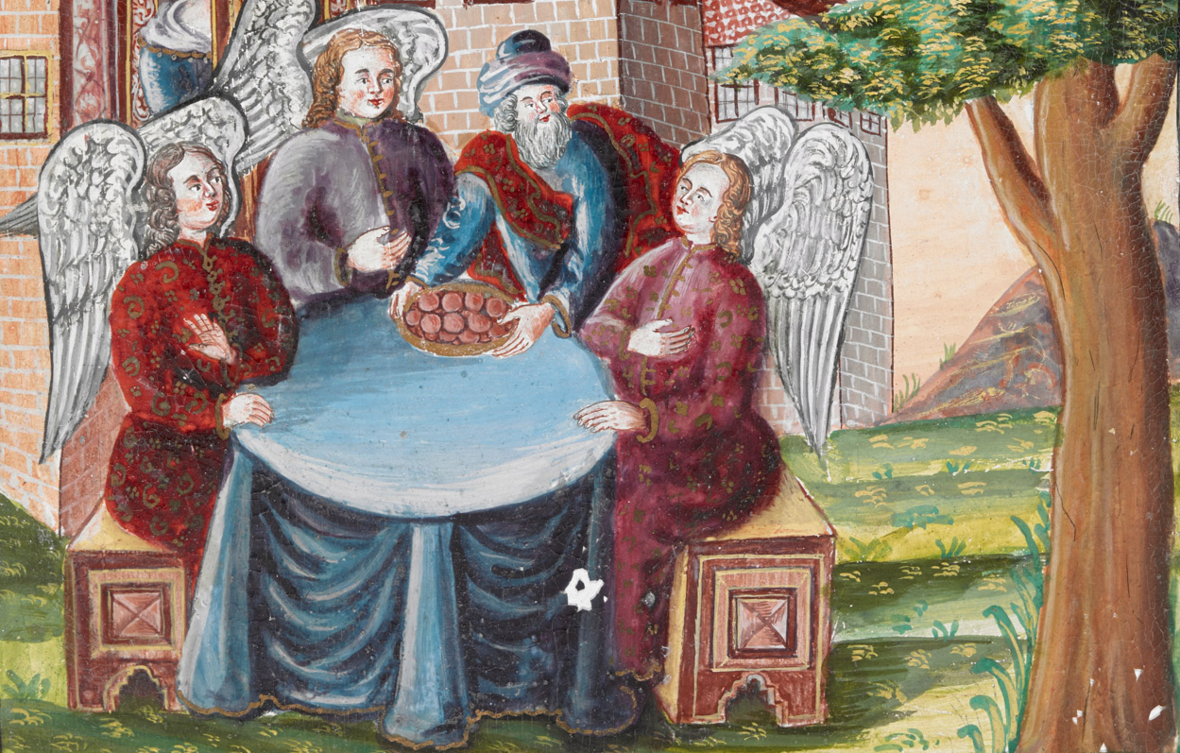
The Jewish people are identified by three primary character traits: "Rachmonim, Bayshonim, Gomlei Chasadim." We are Merciful, Humble, and Kindly (Yevamot 79a). We are spiritual heirs to this legacy from our forefather Avraham Avinu whose commitment to Gemilus Chesed, bestowing kindness, is highlighted in the beginning of this week's Parsha Vayera as he attended to the needs of three Angels disguised as travelers on a broiling hot day.
But as we survey the world around us, can we lay exclusive claim to the mantle of philanthropic largesse? After all, many national leaders and governments provide generously for the welfare of their citizens. And while we may justifiably trace the origins of their social consciousness to Avraham Avinu who spread his message to the entire world, can we now distinguish between the kindness of the nations of the world and the Chesed we Jews practice?
The answer is a resounding Yes! The Chesed of the Jew, particularly as modeled by great Jewish leaders and Tzadikkim, is categorically different from the "kindness" of the world at large. And it comes down to the distinction between the complete selflessness of the Jew on the one hand, and the self-serving selfishness of the nations on the other.
It is plain to see that presidents and prime ministers of the nations are often motivated by revenge and other negative character traits, though some hide it better than others. By contrast, Jewish religious leaders are motivated by the desire to do good to all. They are even quick to forgive those who insult them.
Thus, our Chazal teach (Brachos 9b) that there is great benefit in seeing kings of other nations, solely to see the vast difference between a Jewish king and a heathen king. Similarly, commenting on the verse "tzedakah uplifts a nation," (Proverbs/Mishlei 14:34) Chazal teach that the Jewish people are lifted above all of the other nations of the world through the purity of the Tzedaka they perform, devoid of any ulterior motives for personal benefit (Bava Basra 10b).
But how can we discern the true underlying motive of one who gives tzedakah? The key factor lies in the realm of anonymous giving. One who performs acts of charity and kindness in a very public way is clearly preoccupied with the impression he will make on those who will now give him much honor for his charitable deeds. Often, that individual fully expects that his public displays of generosity will even accrue to his own financial benefit at some point in the future. However, one whose sole concern is the wellbeing of the beneficiary, will gladly give anonymously, giving no thought to any honor or profit he might otherwise receive.
Likewise, people whose giving is driven by self-interest will often restrict their donations to people with whom they share common connection whether familial, national or societal. They give nothing to people foreign to them.
Interestingly, this form of prejudice can even be found in the animal world. In Parshas Shemini, one of the non-kosher birds listed is the stork, called "Chasidah" in Hebrew. Chazal teach (Chullin 63a) that the bird is called "Chasidah" because she performs "chesed" (kindness) with her friends. Many ask, if the bird does so much good, why is it classified as not kosher? The Holy Ruzhiner Rebbe ZY"A answered that the nature of the stork is to perform kindness only toward her own species. She attacks and hunts birds of other species. That is why she is not kosher.
The Chesed of pious Jews, who have elevated their souls through the study of our Holy "Torah of Kindness, (Proverbs/Mishlei 31), knows no bounds and is directed toward friend and stranger alike. True kindness seeks no recompense.
Our great Tzaddikim practiced this lesson, donating large sums of tzedakah anonymously, often to people they did not even know. In this regard, Mr. Aharon Rothman A'H, who was present at the funeral of the holy Rebbe Yaakov of Komarna, ZT"L, recounted the following. The Rebbe's son-in-law, the holy Munkatcher Rebbe, author of Minchas Elazar recounted, "people say my father-in-law was wealthy, and this is true. But his real wealth is only in the World to Come. You see, he had amassed large sums of money during his lifetime. But when he passed and we opened his money chest, expecting to find a fortune, it contained nothing but a note stating, 'I owe a sum of money to so-and-so, please repay the debt'! The holy Rebbe had distributed his last penny, and then some, to poor people far and near. But he did so anonymously, and we only found out about this after he left the world, having received no honor during his lifetime for his prodigious charitable deeds.
Furthermore, beyond merely keeping peace with their friends, many Tzaddikim worried greatly for the wellbeing of their enemies. Chazal teach (Bava Metzia 32b) that there is even a special mitzvah to help one's enemy. This strengthens the character trait of helping all in need.
This ideal of selfless giving can be found in this week's Parsha which serves as the model lesson for the ideal performance of kindness. The verse states, "and Avraham ran to the cattle, and took a young calf which was tender and good and gave it to the lad". Rashi explains that the lad was his son Yishmael. Avraham wanted to educate Yishmael in the performance of Chesed and, therefore, instructed Yishmael to prepare the feast for the guests.
But this begs the question, Yishmael was in pain, as it was the third day after his circumcision. Why did Avraham impose upon him, on this day of all days, to teach him the mitzvah of hospitality? Surely, he could have taught him the same lesson under more comfortable circumstances.
But this was precisely the lesson Avraham sought to impart to his son. Avraham utilized this opportunity to teach Yishmael to perform acts of kindness in an anonymous manner. After all, on such a hot day nobody would be out to see his good deed. Also, the guests came in the form of strangers from a faraway land. Thus, Yishmael had no hope of receiving any material benefit or honor for this deed in the future. This would stand as Chesed in its purest form.
We too must educate our children not to be impressed by the kindnesses performed by the secular world. We must teach them the Chesed of our holy Torah which holds no ulterior motive other than performing the will of Hashem by helping all His precious children.


Comments
Post a Comment